April 2, 2026, 7:10 a.m. |
Tagged under Podcast, autism
Original column for Knack (in Dutch):
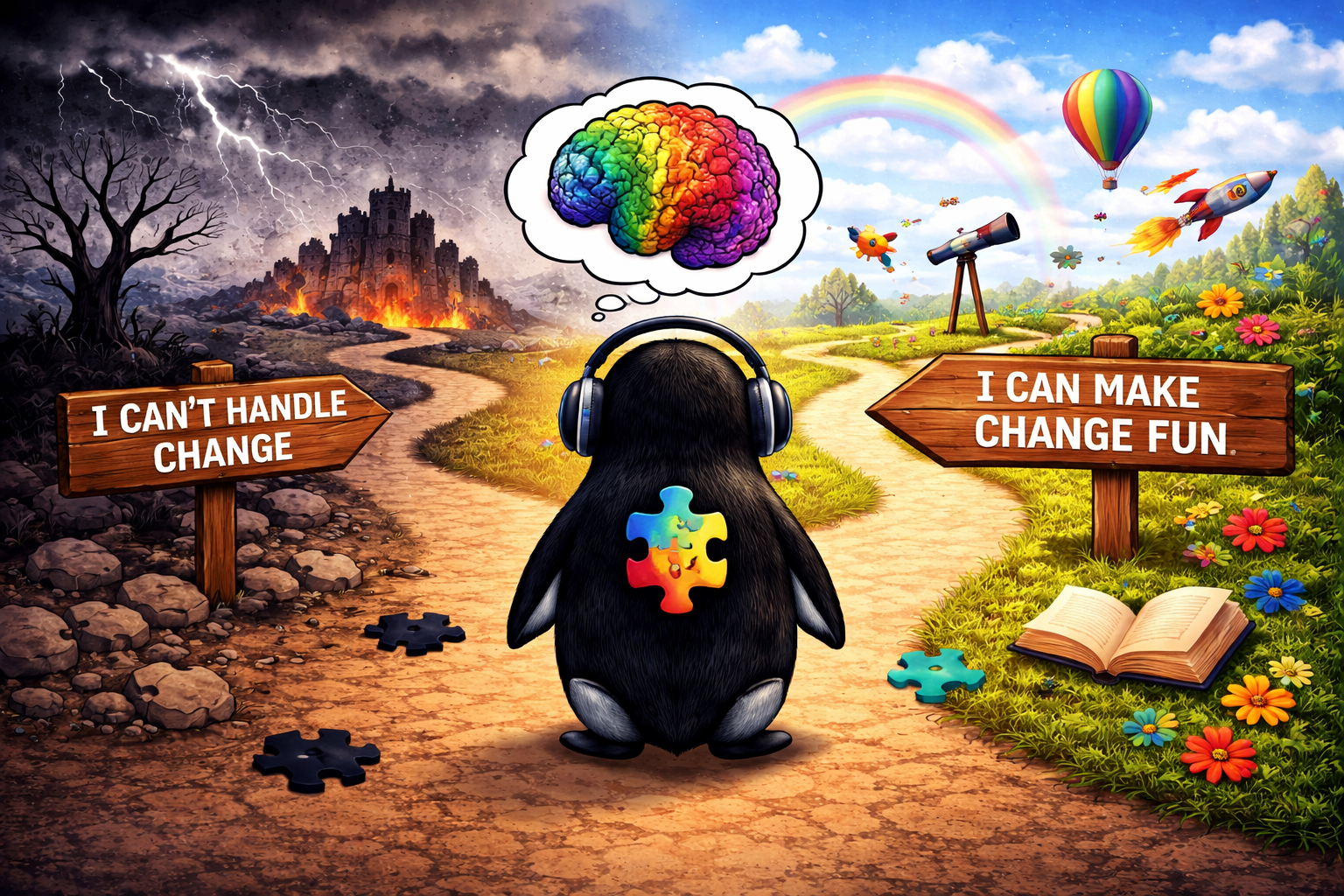
April 2nd is "World Autism Day", and as per yearly tradition, that uncomfortable question comes seeping into my consciousness again: "how am I supposed to feel about this?" Is this a day to throw a (silent-disco) party and celebrate my autism? Or a day to feel sorry for all those poor souls who are forever doomed to have a "disorder" linked to their inherent being? Well, neither views seem particularly nuanced, so I thought I'd examine what I prefer to believe.
I'm indeed using the word "believe" here, although I still consider myself an atheist, because I've noticed that depending on how I choose to define my autism, I'm more or less inclined toward a chain reaction of self-destructive behavior. But who am I to question the official "autism as disorder" narrative and go preaching my own belief? Isn't it just an inconvenient truth? Maybe I'm not made for those beautiful things in life, like surprises and human connection? Doesn't my questioning arise from a resistance to walk my own reality? Maybe. But since, according to some, one of my traits is that I can’t stop having long monologues, I’ll use the excuse to go on rambling a bit more.
But let's zoom in, because what even is the "official" definition of autism? If I ask ten people at a lecture to define autism, I get ten different definitions. But let's be honest, a definition is nothing more than consensus anyway. If we decide that wearing a red hat on Sunday turns out to be a diagnostic criterium for an underlying disorder called "autism," then that's what it is, as long as we all agree to use the same definition from now on.
In the end, we all just believe the stories that help us survive, nobody cares about the truth anyway, right? For instance, I was bullied as a child. Okay, nobody peed in my lunchbox, but I was reduced to certain traits that served as comic material for my peers. And I wasn't seen as anything more than that. I would have preferred to be truly, completely invisible instead. So what was I supposed to believe? That I was unlucky, that I had no way to escape that situation, and that it would be a few more miserable years? That's not exactly something that fills a person with hope, is it? Fortunately, I had a much better solution! I was simply inferior to the rest, eureka! That way I could justify the comforting thought that I'd better become as invisible as possible. Just gaslighting myself a little in the name of safety.
But what on earth does this have to do with autism? Well, I remember how I finally received my diagnosis during a period when I felt quite miserable. My physiotherapy internship wasn't going well, and even my supervisors at Ghent University belittled me, saying "I'd be laughed at if I ever had to work with children." Fortunately, I eventually met people who did have some pedagogical insight, and I finally got my diagnosis. And then I felt something I hadn't felt in a long time. Hope. And that's how I ended up with a "auti-coach," who taught me to plan everything in my life. She teached me that I couldn't handle change, and in doing so gave me the perfect rationalization to banish everything beautiful that unpredictability or social connection could offer me from my life. And yes, just like with the bullying, I once again believed wholeheartedly in the self-denigrating version, that I was limited in my being. It gave me (the illusion of) safety, yay, but made me severely depressed. Why be happy when you can be normal right?
This new "religion" brought my level of depression to a record high, until I had no choice but to ask myself why I had become this way. As far as my psychological knowledge reached at the time, I thought behavior always developed for a reason — but was I some magical exception? I started looking things up and read that people with autism might have an extreme predisposition to notice change. For instance, maye I needed some time to formulate an answer when I was young, because I felt so much (nuance), but I also learned to predict that I'd be punished for that? The "best" option I could come up with as a child was perhaps to start avoiding change and social situations altogether, and to learn my "autistic behavior."
And so hope began to seep in — that there had once been a well-intentioned reason for the behavior that was now apparently destroying me, and that maybe there were other options now? But I got a strange feeling. That hope I had been searching for, it turned out I didn't want it at all. I was too afraid that if I saw that the "safety department" of my brain had an off-switch, I'd be stupid enough to actually press it. I preferred to stay blind, anything as long as I wouldn't feel that my planning-orientation, that feeling of always needing to stay one step ahead of the world, was no longer necessary! Or that the story of "connection and change are unsafe" was a well-meaning fable, that was never meant to be believed forever.
Because, without my protective behavior, I risked becoming a blank page. All that planning and avoiding may have made my life a living hell, but at least I had a flowchart for that hell. Fortunately, the alternative to the blank page was completely going under, so I figured I had no choice but to try exactly what I told myself was not possible for me. And that also meant finally being open to the possibility that not everyone would thank me for wanting to become a child again, one who doesn't mindlessly execute instructions like an adult, but takes the time to yet discover them. And so I learned, thankfully, together with a therapist who (finally) had more credentials than an inspiring LinkedIn title, to see rejection as a process of natural selection that magically brought me to the right people and even companies. Where I was fully allowed to take my time to form my nuanced opinion and could say "cheerio, this is a bit too much for me right now."
Nevertheless, I need to keep my feet on the ground. I still don't have an answer to the question "who I am," let alone how my autism precisely contributes to that. But I have learned that I may have started asking this question for the wrong reason. Maybe there is no "Steven" I must find, because in the right circumstances, I shouldn't have to be any particular someone? Protecting myself was once necessary, true, but wouldn't it be a shame to never be more than that? That this is terrifying is also true. But, believing that I can never let the impetuous child inside me go out and play again, because due to a disorder it simply can't handle change, what kind of cruel love would that be?
#autism #ASS #neurodiversity
 Donate